Installation of KTWR's 30KW solar power system has been completed. It turned out to be a tough thing to do during rainy season. It is also not so easy to get full power output during the monsoon that we had just experienced. However, this photo shows the inverter pumping over 22KW into the power lines at the station. That is ~3 times the power that we consume at home when a water heater and two air conditioners are running.
We are already in the planning stages of expanding this system with an additional 37.5-67.5KW system. That would be plenty of power to make our power meter "spin backwards" during the day. This will cause KTWR to accumulate credits that can be used to reduce the power costs of our nightly broadcasts. Reduced costs will expand our ministry opportunities.
Search This Blog
Friday, September 26, 2014
Friday, September 19, 2014
Matrix Now in Use
We had a very busy day today (September 19th). This was the day we had to move connections for two antennas and one transmitter to the antenna switch matrix. We were a bit concerned when the day started off with thunderstorms, but the weather turned out to be good for most of the day.
Once we cut the antenna feedlines apart, we were committed to getting the job done. As can be seen from the photos, most of our staff worked on this day-long task. Antennas 2A and 2B are connected at one corner of the matrix. TX7 is connected to the opposite corner.
TX7 tuned to the new connection very well. It should work better than it did with the temporary switch connections in our old dump truck.
Friday, September 12, 2014
When it Pays to Cut Corners
The antenna switch matrix was tested for its ability to maintain the proper impedance with various transmitter-to-antenna connection combinations. The transmitters ideally want to see 300 Ohms with no reactance as the RF power travels from the transmitter to the antenna. That perfect situation almost never happens, so the transmitter must tune to make up for mismatches. Our matrix is unique in that there are cases in which it allows multiple switch paths between particular transmitters and antennas. Each path must appear the same to the transmitter to avoid extra time spent in tuning.

Maintaining the proper distance between conductors helped the matrix exhibit the 300 Ohm resistive load. That was not particularly difficult. Keeping the reactive load as close to 0 as possible was more challenging. Quite a bit of work went into using 45-degree fittings to avoid 90-degree corners. Sharp corners add inductance. Too much inductance can cause problems in transmitter tuning.

The good news is that the measurements were nearly perfect for all switch combinations at all frequencies in the 6-18MHz range. Avoiding the sharp corners in the pipes really paid off. The transmitters will essentially not notice when the matrix is connected between the antennas and the transmitters.
We are currently working on verifying that the automated switch control will work. Once this is proven to work, TX7 and ANT2A/B will be connected to the matrix. Other transmitters and antennas will follow during the next several weeks.
Maintaining the proper distance between conductors helped the matrix exhibit the 300 Ohm resistive load. That was not particularly difficult. Keeping the reactive load as close to 0 as possible was more challenging. Quite a bit of work went into using 45-degree fittings to avoid 90-degree corners. Sharp corners add inductance. Too much inductance can cause problems in transmitter tuning.
The good news is that the measurements were nearly perfect for all switch combinations at all frequencies in the 6-18MHz range. Avoiding the sharp corners in the pipes really paid off. The transmitters will essentially not notice when the matrix is connected between the antennas and the transmitters.
We are currently working on verifying that the automated switch control will work. Once this is proven to work, TX7 and ANT2A/B will be connected to the matrix. Other transmitters and antennas will follow during the next several weeks.
Saturday, September 6, 2014
Little House on the Prairie
After a lot of hard work and dry weather, we managed to construct a little block building to house the antenna switch controller and the power panel. The forklift definitely made the bucket brigade for pouring the roof concrete much easier.
While the concrete was setting, a trench was dug between the transmitter building and this block house. Conduit and power wiring has been installed and the trench has been refilled. Conduit and its associated power and control wiring has also been installed between the block house and the ten antenna switches.
The switch controller and the power panel have been mounted inside the block house, but are not yet fully connected to other equipment. We should be able to do some testing of the switches next week, unless something unexpected comes up. (Something unexpected nearly always changes our plans.)
While the concrete was setting, a trench was dug between the transmitter building and this block house. Conduit and power wiring has been installed and the trench has been refilled. Conduit and its associated power and control wiring has also been installed between the block house and the ten antenna switches.
The switch controller and the power panel have been mounted inside the block house, but are not yet fully connected to other equipment. We should be able to do some testing of the switches next week, unless something unexpected comes up. (Something unexpected nearly always changes our plans.)
Tuesday, August 19, 2014
Panels are Up
The installation contractor has made good progress with the solar power array at KTWR. All 120 panels have been installed. One interesting side benefit that had not occurred to us before is that the panels make a nice shaded area for picnics or just relaxing. The installers took advantage of that fact because the sun has been brutal for the past several days.
The contractor will work on the inverter and wiring this week. We hope to have this system providing power by the end of the month.
Thursday, August 14, 2014
Steel Henge
We seem to have gotten into the habit of erecting things that resemble ancient astronomical tools. This photo shows that good progress has been made with our 30KW solar power array. The most difficult part of the entire project was to get the posts aligned and set in concrete. With that milestone passed, installation of the arms and rails that hold the solar panels has been going quickly. It is expected that at least some of the panels will be installed tomorrow.
After the panel installation, what remains is installing the inverter and the wiring. Once this is done, we hope to save quite a bit of money on our power bills.
Playing in the Mud
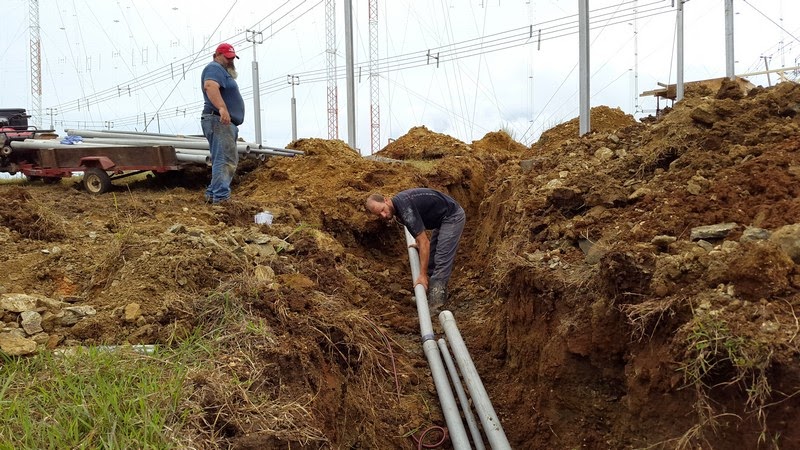
Since this is rainy season on Guam, digging in the dirt is actually a messy process. That is what we faced when trenching for the power and control lines for the antenna switch matrix. The conduit that houses these lines will go from the transmitter building to the concrete block structure shown in the distance to the right in this photograph. The controller that manages the switches and the power panel will be housed in that structure.
Once the power and control lines are connected to the equipment in the block building, there is still quite a bit of connection work to be done. Each switch must be connected via conduits to the block building. After that is done, we can test the controller and the switches. The matrix tuning process will be the next step. That will be done to improve the performance of the transmitters and the antennas.
Subscribe to:
Posts (Atom)