Search This Blog

Monday, July 27, 2015

Arrival of the Dummy Load

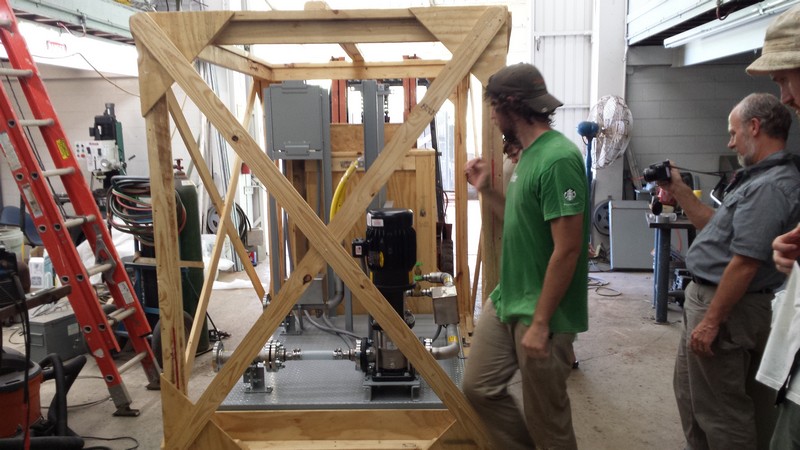
Today, the long-awaited dummy load arrived at the transmitter site in two installments!  We will use the new dummy load to test our transmitters without broadcasting radio waves over the air.  Through the process of sending many kilowatts of RF energy into the dummy load, a lot of heat is created.  Therefore, the dummy load comes with an enormous chiller and a big pump to move refrigerated water to cool off the dummy load.  This particular dummy load has a 300kW capacity, which is plenty for our purposes here at the site.

First, the chiller for the dummy load was loaded on to a flatbed truck and sent down to the site.  We fired up our trusty forklift, and Phil gracefully lifted the awkwardly long chiller off of the bed of the truck.  The driver then pulled the truck forward and out of the way so that Phil could guide the chiller and set it down in its resting place on the covered concrete pad at the back of our building.

After lunch, the moving truck showed up again with the actual dummy load.  Although it is smaller in size, the dummy load proved more difficult to move than the chiller.  We needed to rotate the dummy load on the flatbed before we could pick it up with the forklift.  Once we did that, we set it down inside the shop at the back end of the building.

The next step will be to build a structure for the dummy load to reside in where it will be protected from the elements, and to move the chiller to its resting place on three concrete footers that we poured next to the retaining wall for the antenna switch matrix.
The chiller arriving on a flatbed truck.
Our photogenic intern, Sol, with the chiller in the background.  Also, it's a beautiful day on Guam! 
Phil picking the chiller up off of the flatbed with the forklift.

Phil setting the chiller down in its resting place on the back porch.
George striking a pose with the dummy load upon its arrival.
Phil carefully rotating the dummy load on the flatbed.
And we're up!
Phil setting the dummy load down in the shop.
Unwrapping our present!
The team checking out the new toy.
The concrete footers where the chiller will rest.


Tuesday, June 23, 2015

Sidecat Anchor Replacement

The broken anchor.
One of the causes for antenna one's damage during the typhoon was that the anchor for the support cable on the side of the antenna was ripped out of the ground.  This anchor is hooked into a reinforced cement block buried under about six feet of earth.  Over years of oxidation and corrosion, certain spots on the anchor became thinner and thinner until the anchor broke in half during the strong gusts of the typhoon.  This break increased the stress on the other support cables, and resulted in broken drop lines and the tangled web of metal and ceramic insulators shown earlier.

In order to prevent this from occurring on all the other anchors, we had poured a cylindrical concrete form to protect the anchor from corrosion and add additional stability and strength.  However, this had not been done to the anchors on antenna one before the typhoon.


Temporary "anchors".
To fix antenna one's anchors, we temporarily connected the side support cables to two vehicles to hold the antenna in place while we fixed the anchors.  Next, we dug holes to get to the buried concrete blocks, and chipped away concrete to expose the steel rebar so we could attach the new anchors.  Once we attached the anchors and set them at the proper angle and direction, we poured the concrete into cylindrical forms around the anchors.  The next-to-last step was to backfill the holes we had dug, and to wait two weeks for the new anchors to set.  Finally, we reattached the side support cables to the new anchors and tensioned the cables to the proper load.  And just like that, antenna one was completely repaired!


Reattaching the anchor and pouring the concrete tube.
Backfilling around the anchor with dirt.
The cables are reattached to the anchors, much to Sol's delight.


Thursday, June 11, 2015

Slew Switch Motor Replacement

Since the beginning of the broadcast season in March, we have been limited in our use of antenna three.  Although the antenna can potentially broadcast in three directions, we can only use one of those directions (or slews) per shift.  This is because the motor that powers the slew switch has not been working properly.  In order to restore the slew switch to its proper functionality, we replaced the old motor with a refurbished motor, and replaced the wires that run from the relays that control the motor to match the color-coded system in our schematics.

 
Now that the motor has been replaced, we have the potential to use any of the three slews on antenna three during our broadcast shift.  However, this improvement came with a cost, as Mike painfully discovered where some wasps had been nesting in the struts that support the slew switch...

Transmitter Maintenance

Since the site has been in project mode for so long, continuously working to improve the operation of the site, it has been difficult to keep up with the scheduled maintenance of the transmitters.  However, with our new intern, Sol, and the Brunson family, who are here on Guam for a vision trip as they work towards raising financial support to join the team, we have the manpower to perform some overdue maintenance of the transmitters!

First up, our 100kW HCJB transmitter!  We vacuumed out and wiped down the different compartments of the transmitter, changed the water in the cooling system, replaced the weatherstripping on the doors of the modulator cabinet, and visually inspected for any damage.

Next up, our two 250kW Thomson transmitters!  We opened up the transmitters, cleaned all the different compartments, and visually inspected for any damage.

It was helpful to have the manpower necessary to complete these tasks in one day.  We are looking forward to the day when all of those raising support to join the team here on Guam, so we can keep up to date with these tasks that help ensure the reliability that we strive for!


Antenna Repair

 As you all know, the transmitter site was hit by Typhoon Dolphin back in mid-May.  It is definitely past time to inform you all about how the repairs are going!  The week after the typhoon hit, we immediately went into recovery mode.  We contacted local churches to assemble crews of volunteers to come out and help with the repairs.  We also had our friend, Sterling, come out from the States to help with the antenna rigging.  It was encouraging and exciting to see so many people sacrifice time and energy to help with the difficult task of getting the antenna back up and running!

The first major task was to lower the broken antenna.  Sterling and Andrew climbed the antenna towers to attach clamps to the top support cable of the antenna.  They disconnected the broken antenna and reflector screen from the towers, and the team used a system of cables and pulleys to slowly lower the antenna safely to the ground.


Once the antenna reached the ground, our hearty crew of volunteers worked to separate the screen from the antenna (above).  The act of lowering everything down at once, while the safer option, caused the screen and the antenna to get tangled up.  It took a few hours of careful puzzle-solving to separate the two.

After we separated the antenna and the reflector screen, our crew went to work scouring the antenna dipoles and replacing any broken pieces (left).  Next, we patched the antenna dipoles back together and slowly raised the antenna back up, row by row (below).

A week after Typhoon Dolphin damaged our antenna, we were back up and running!  We are grateful for all the volunteers' help, thankful for no major injuries, and we praise God that the switch matrix allowed us to shift programming around in order to minimize the loss of air time!

Finished!


Monday, May 18, 2015

A Dolphin We Did Not Want to See

Many of you have heard about Typhoon Dolphin's arrival on Guam last Friday. Most of Guam lost power and some areas lost water service. Even telephone service has been problematic in many areas. The utility crews have been working hard to get things back to normal. We still do not have power at KTWR, so we have been running our generators.

Dolphin managed to mangle ANT1 during its visit. We are quite grateful that the antenna matrix allows us to use other antennas, so that all of the programs can continue to be aired. There was some minor damage to ANT2A, but we can still use it.

ANT1 must be rebuilt. This process requires several people, so we have been getting help from local volunteers. It will take over a week to lower the antenna, rebuild it, and raise it back up. Please pray for safety for the workers. The antenna field is definitely a hardhat area. Please also pray for endurance and wisdom for those involved in this project. It is very hard work and the weather is quite hot and sticky.

Wednesday, May 6, 2015

Security Fence is Up


After installing the first phase of our solar panel array in September 2014, the panels were left open and unprotected on a hillside on our property.  With so many different projects going on throughout the past few months, we haven't gotten around to installing a security fence.  Since the work on our other projects, such as the switch matrix, has slowed down after the broadcast season change, we took this opportunity to build the fence!

With the fence complete, phase one of our solar project has come to a close.  Currently, we are in the design and engineering stages of the second phase.  We are hoping to install the next phase in July before the rainy season gets underway.


Using a two-man auger to drill the holes for the fence posts.

Paul and Phil cutting the fence posts to 10-foot lengths.
The fence posts are in place!
 
Stretching out the chain link to attach to the end posts.


Voila!  The completed fence!