Search This Blog
Sunday, October 30, 2011
Lying Down on the Job
Monday, October 3, 2011
Antenna Question
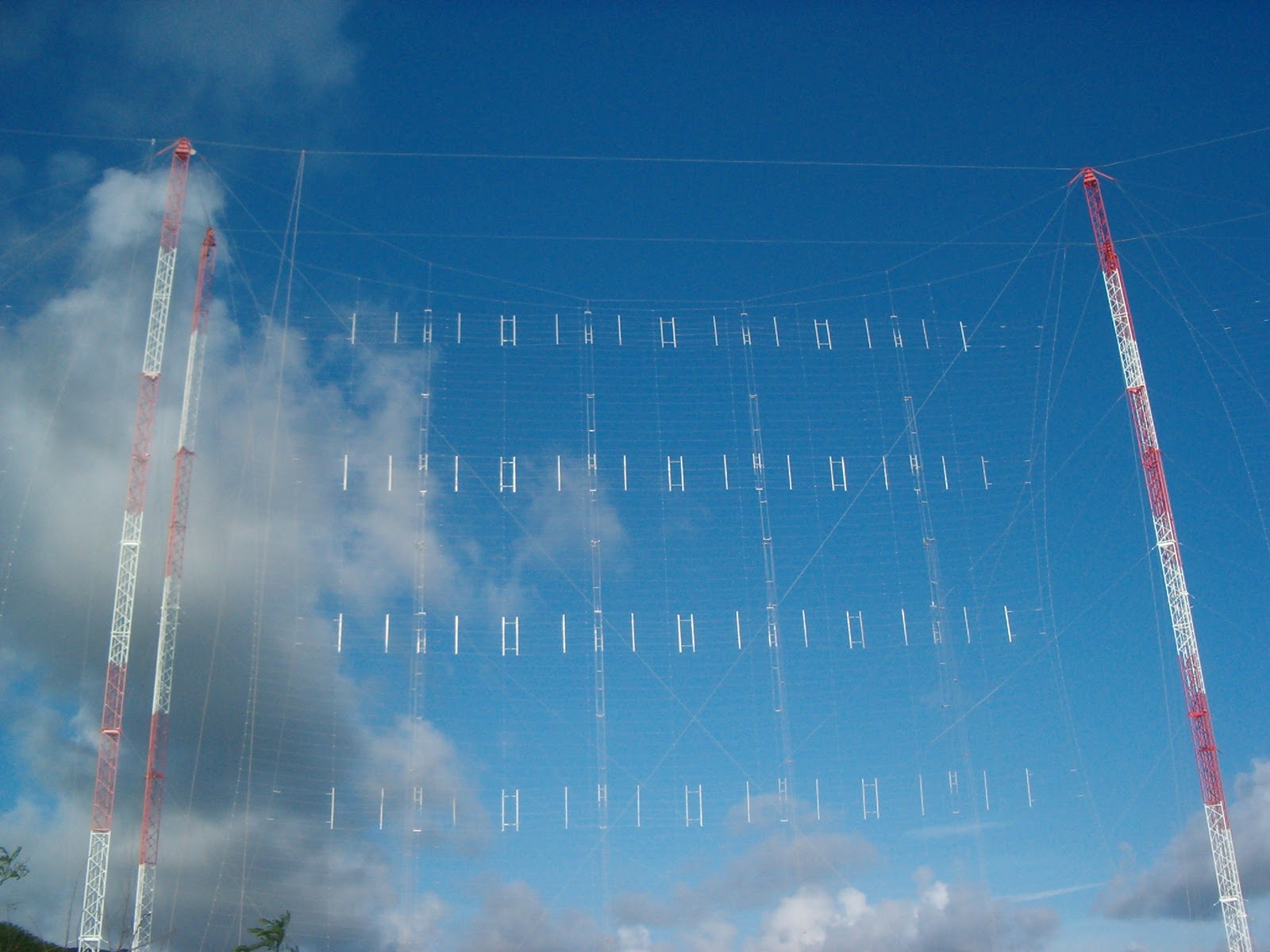
The antennas at KTWR are all curtain antennas made of dipole arrays. The one we used in the test is nearly identical to the one shown at the right. It is configured as a 4x4x1.0. This means it has 4 columns of 4 dipoles each with the bottom dipole being one wavelength above the ground. There is a reflecter screen hanging behind the dipoles to force the signal to have one main beam instead of two. The gain of this antenna can be as high as 22dB, depending on frequency and slew angle. That makes the 75KW signal coming from the transmitter seem like 11MW heading to desired coverage area.
The direction of the main lobe of the broadcast signal is controlled by the slew box like the one shown to the left. In the case of the antenna used for the DRM tests, the azimuth can vary from 290 to 345 degrees. We used 290 degrees for the tests beamed toward India. Some of the signal went to other places outside the main coverage area. That is why people in Japan, Australia, and Brazil were able to hear the test broadcasts.
One problem with the tests was that signal propagation conditions in the ionosphere did not allow the signals to be received in India, as far as we can determine. Had we performed these tests at night, the signal would probably have been very strong there. A great deal of planning goes into the frequency choice and the timing of our broadcasts, so that they will be reliable for the entire broadcast season.
Friday, September 16, 2011
Wave of the Future
Friday, September 2, 2011
More Testing
A few more accomplishments at KTWR…
We have not been able to work on the HC100 upgrade for a long time, due to the Thomson transmitter installation and other complications. We felt it would be a good idea to test the content server so…We are very Happy to report the Content Server Works Very Well!!
Tuesday, August 9, 2011
Testing, Testing, Testing... and... RF ON!
Considerable progress has been made in Connecting Power, Air and Water cooling systems. Most connections were completed just before Marc Moreau (Thomson Engineer) arrived for an Installation evaluation and inspection.
Marc arrived on August 3rd with the Transmitter in a functional unknown state.
For the next week the project team worked 12 to 14 hour days testing, repairing electrical control components, fixing water cooling leaks, rebuilding computers, etc….
On Tuesday morning August 9th a temporary antenna connection was made.... and....
We are pleased to report on 9 August 2011
we successfully accomplished an initial power up RF test. For about 10 minutes we aired a station ID test and music tone at 0500 UTC on 31M at 57KW.
9 August 2011 Thomson Transmitter status display indicating all systems "ON":
Thank you for your continued prayers as we move forward to reach the Late October goal for sustained broadcasts using this powerful communication tool!
RF Test Video
Friday, July 29, 2011
Raising The Balun - 2