Search This Blog

Wednesday, October 3, 2012

Cable Wrestling

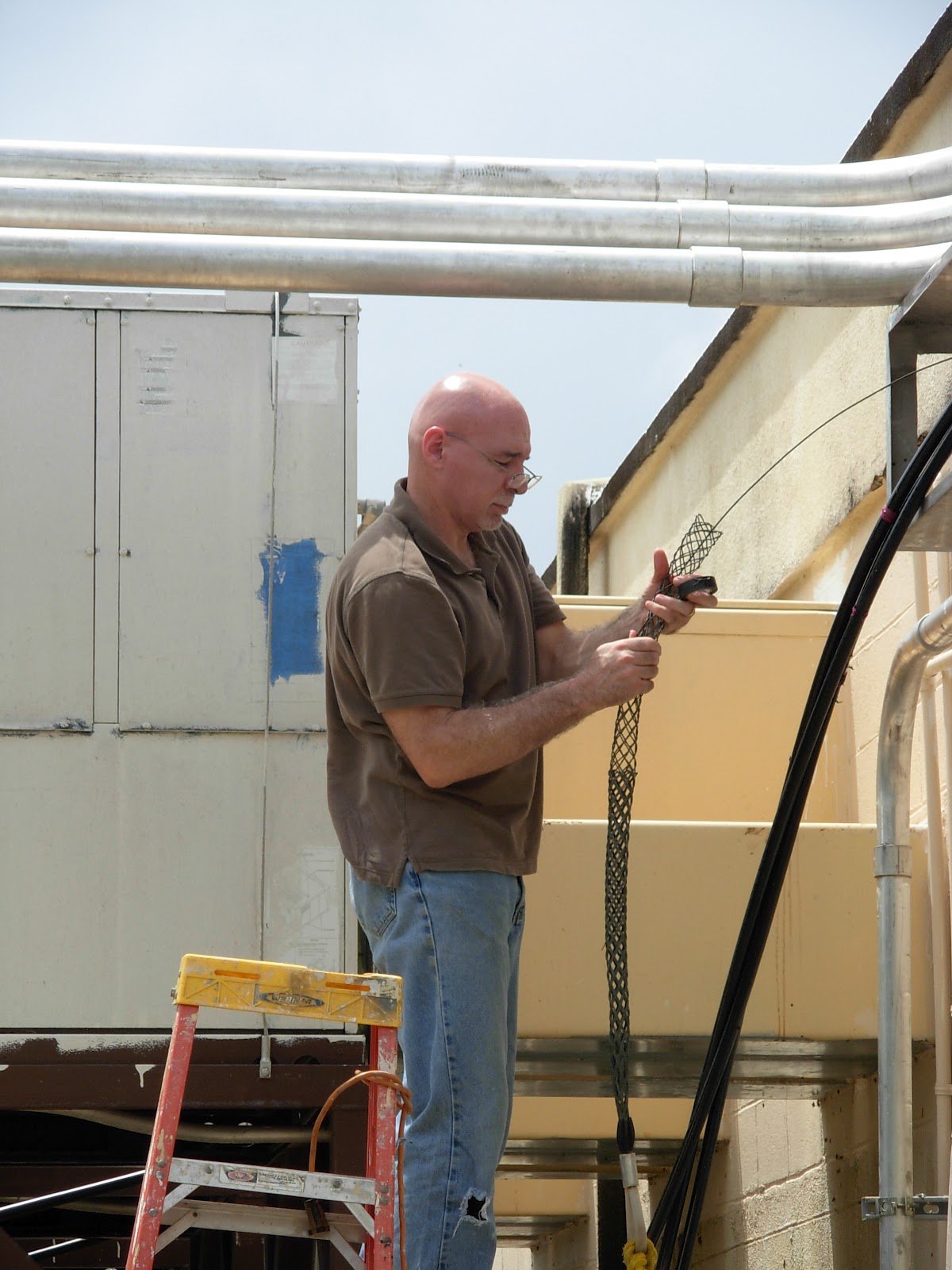
Perry preparing the basket for the next pull
We realize that it has been quite a while since we updated this blog.  Not much had happened that related to the installation of the second new transmitter.  We needed time to catch up on other tasks.

Now we can report that work on TX7 has begun.  One of the first things that must be done is running the electrical wiring to the transmitter.  This is not a trivial task due to the size of the cables and the conduits.  It takes five people to pull one set of cables through the conduit.  Even with that many people, we wound up using a truck to do some of the pulling. 

We did run into some hitches with part of TX7.  Some ceramic insulators broke, so more must be ordered.  This put the tube socket rebuild on hold.  We have plenty of work to do without being stuck waiting for the parts.
The guys wrestling conduit and stiff cables simulataneously

Tuesday, April 24, 2012

Catching Up!

In the face-paced world we live in, who can’t attest to the need for “catch up” at times?   It is no different at KTWR!  More than a year of intense work focused on the transmitter project took its toll on the regular maintenance around the station, especially tasks like the antenna maintenance.  Hence, the quiet nature of this blog recently, which you probably have noticed!

Antenna maintenance is a lengthy process.   It starts on the ground with inspection of all the hardware for the tower guys, antenna drops and ground rods.  

The humid, salty environment we experience here is rough on this equipment.  Recently the tower anchors were dug up, inspected and repaired as needed.


In addition to the inspections on the ground, inspection must be done in the air. Many of the dipole wires need to be replaced due to rust. This is a tedious process, and one for which we covet your prayers for protection for the guys!


Tuesday, December 6, 2011

What's Next?

We realize that it has been a while since you heard from us.  In case you missed the news, TX6 is on the air with regular braodcasts to Northeast Asia and India.  Even though we are running it at 125KW (half power), the signal reports have been very encouraging.  Some people are hearing us for the first time in years.

We are currently working to make sure we can operate TX6 for many years to come.  Much of that work is consumed in locating and aquiring spare parts to fill gaps in our stock room.  Once this is done, we can put more effort into getting TX7 on the air.  There are some things we can do in TX7 now. 


Here is Jeff inserting modules into the modulator section.  One reason this was done now is to make room for other equipment in the container in which these were stored.  An amazing amount of space can be created just by stuffing parts into these large transmitters.

Speaking of Jeff, he has been on Guam for a few months and will stay into the middle of next year.  He will function as the chief engineer while Mike is in the States for his furlough.  Jeff will be helped by Phil, a short-termer working as a technician.  Short-term help like this is very handy because our permanent staff is so small.  We can definitely use more engineers and technicians at KTWR for career and short-term service.

Sunday, October 30, 2011

Lying Down on the Job

Many of you knew about our cooling system problem with TX6.  The old pump was overloading due to it spinning too quickly on our 60Hz power.  We received a new pump by way of a lot of help from ministry supporters.  We were able to swap the pumps and get the new unit working in one day.  We spent quite a bit of time lying down to get the job done.
The transmitter has been working well in short test broadcasts.  It even helped us find a problem with another transmitter.  All the while, it is keeping its cool.  It's a good thing because the new broadcast season starts tonight.  It will be broadcasting the Good News to China, India, and North Korea.  Listeners in India have already been very excited with the good signals coming their way. 

Monday, October 3, 2011

Antenna Question

We received a question about how the antenna used in our recent DRM tests affected the signal.  Now we get to tell you about an important part of our station that seems to be the most unknown to most of our readers.
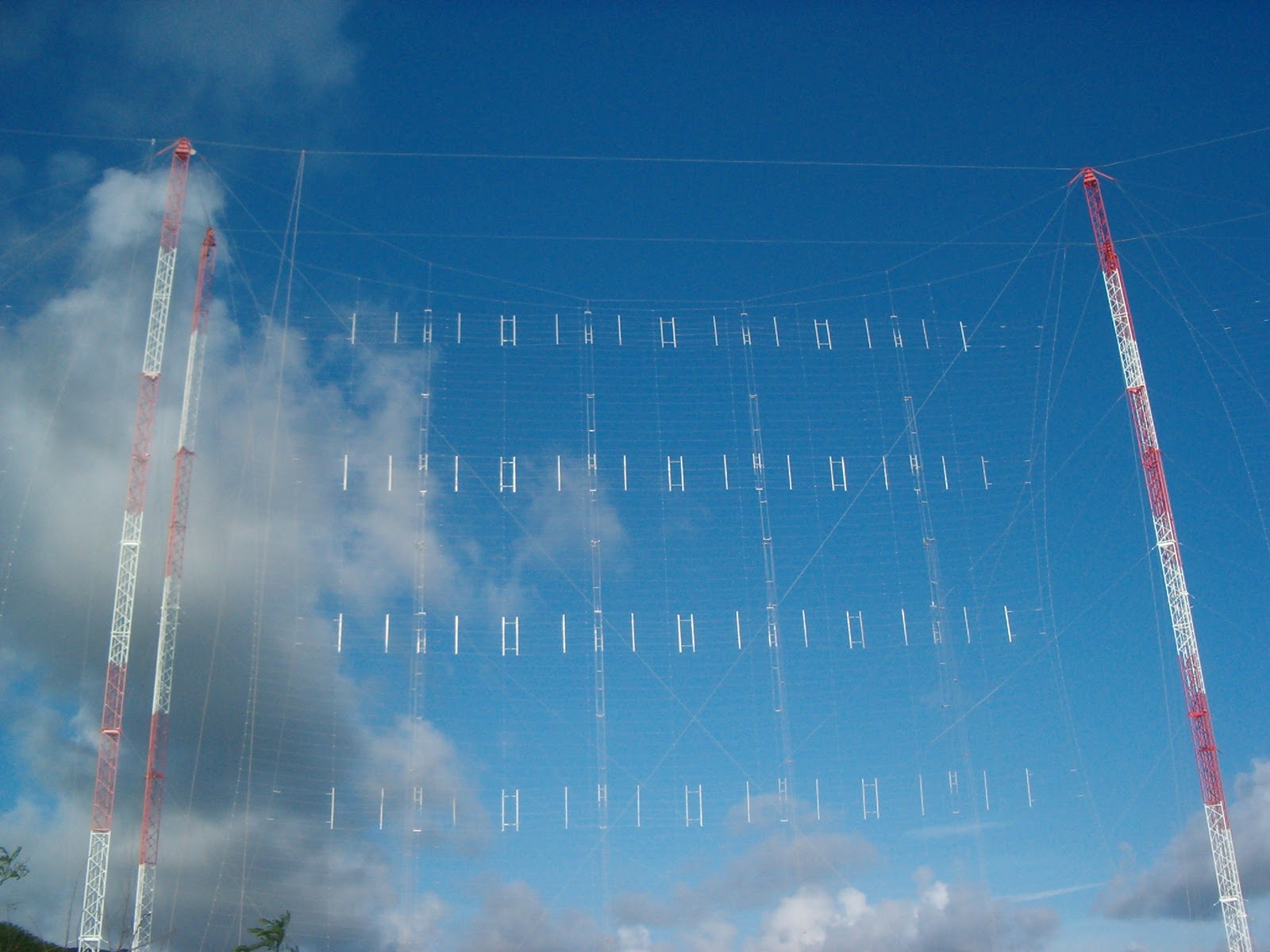
The antennas at KTWR are all curtain antennas made of dipole arrays.  The one we used in the test is nearly identical to the one shown at the right.  It is configured as a 4x4x1.0.  This means it has 4 columns of 4 dipoles each with the bottom dipole being one wavelength above the ground.  There is a reflecter screen hanging behind the dipoles to force the signal to have one main beam instead of two.  The gain of this antenna can be as high as 22dB, depending on frequency and slew angle.  That makes the 75KW signal coming from the transmitter seem like 11MW heading to desired coverage area.
The direction of the main lobe of the broadcast signal is controlled by the slew box like the one shown to the left.  In the case of the antenna used for the DRM tests, the azimuth can vary from 290 to 345 degrees.  We used 290 degrees for the tests beamed toward India.  Some of the signal went to other places outside the main coverage area.  That is why people in Japan, Australia, and Brazil were able to hear the test broadcasts.
One problem with the tests was that signal propagation conditions in the ionosphere did not allow the signals to be received in India, as far as we can determine.  Had we performed these tests at night, the signal would probably have been very strong there.  A great deal of planning goes into the frequency choice and the timing of our broadcasts, so that they will be reliable for the entire broadcast season.
Friday, September 16, 2011

Wave of the Future

We have had an encouraging learning experience during our DRM test transmissions. The spectrum analyzer display shows the typical "Bart-head" waveform that a DRM broadcast creates. TX6 was able to acheive a "shoulder depth" of at least 32dB, which is quite good.
There are still bugs to be worked out with the data being sent from the content server to the modulator in the transmitter. These bugs are creating occasional breaks in the audio. However, the sound quality is amazing for a shortwave broadcast. We have received listener reports from Japan and Australia. The main beam of the 75KW signal was actually headed toward India.  You can go to www.youtube.com/watch?v=6e2Lnmx2LU4 to hear the signal that was received in Japan.

Friday, September 2, 2011

More Testing


A few more accomplishments at KTWR…
 
75% Power Test
With the Antenna connection completed, we are now able to test The Thomson Transmitter at higher power. On August 31 we were able to bring the Thomson transmitter to 218KW. The transmitter ran smoothly with very low reflected power.


Content Server Test

The Transmitters at KTWR Guam are two Harris SW100 Transmitters (100KW), one HCJB HC100 Transmitter (100KW) and now the two reconditioned Thomson TRE2326 transmitters (250KW).
We have had an ongoing project to upgrade the HC100 Transmitter to DRM (Digital Shortwave) for several years. One of the devices needed to broadcast digitally is a content server which formats audio into the correct form of digital audio.
We have not been able to work on the HC100 upgrade for a long time, due to the Thomson transmitter installation and other complications. We felt it would be a good idea to test the content server so…
We configured the content server to stream Digital content to the new Thomson transmitter because the Thomson is already DRM capable.
Here are the results.
Sept 2nd 75KW DRM


We are very Happy to report the Content Server Works Very Well!!